Curriculum

Clinician-built enablement for overcoming medication access barriers

Practical tools, smart phrases, and frameworks — clinician-authored and built for use at the point of care. Available for individual enrollment or organizational licensing.

Enroll individually in the RN or Prescriber certificate course (one-time fee, 365-day access), or license the course for your entire health system (annual, per-provider). The Clinical Operations Package is a separate point-of-care reference tool, available individually or by site license.

These courses are available for professional development. They are not currently accredited for continuing education credit.

Courses are self-paced and asynchronous. There are no scheduled sessions, live instruction, or moderated discussions. Some modules are optional — see each track for details. To receive a certificate, learners must complete all required modules and achieve a score of 80% or higher on each module quiz. Contact hours on your certificate reflect the number of modules completed — up to 10.25 hours for the RN Track (7.50 hrs required; includes 0.75 hrs workbook/reflection) and up to 11.25 hours for the Prescriber Track (9.50 hrs required; includes 1.75 hrs workbook/reflection). These courses do not constitute clinical advice and are not a substitute for independent clinical judgment. Technical support is provided by Thinkific.

Filter by audience

For prescribers

Medication Access in America: Navigating the System — Prescriber Track

Prescriber Track

Audienceprescribers
Modules12
Available asProfessional development
FormatSelf-paced, online
PlatformThinkific
Enroll on Thinkific

A 12-module course (Modules 0–11, plus Module 9B — an included update on 2025–2026 policy developments) designed for physicians, nurse practitioners, and physician assistants. Covers the full medication access landscape — from the drug supply chain and PBM ecosystem to specialty biologics, generic shortages, rare disease, drug pricing reform, and the prescriber's role as patient advocate. Includes a prescriber-specific workbook and prescriber-specific quiz questions built for prescribing practice and clinical decision-making. Quizzes are distinct from the RN Track — questions are written for prescriber scope, authority, and clinical workflows.

What this course covers

  • Module 0: US Prescription Drug Supply Chain0.50 hrs
  • Module 1: The Patient Journey0.50 hrs
  • Module 2: The PBM Ecosystem0.50 hrs
  • Module 3: The Payer Landscape0.50 hrs
  • Module 4: The Medication Cost Crisis0.75 hrs
  • Module 5: Specialty Drugs, Biologics & Biosimilars1.00 hroptional
  • Module 6: Generic Drugs, Shortages & Pharmacy Deserts1.00 hr
  • Module 7: Insulin — A Complete Case Study0.75 hrs
  • Module 8: Orphan Drugs, Rare Disease & Ethics of Extreme Pricing1.00 hroptional
  • Module 9: Drug Pricing Reform — What's Actually Changing1.00 hr
  • Module 9B: Update 2025–2026 (included update, not a standalone module)0.50 hrs
  • Module 10: The Prescriber as Navigator & Advocate0.75 hrs
  • Module 11: ClinicalTrials.gov as a Medication Access Tool1.00 hr
  • Prescriber workbook & reflection1.75 hrs
The course

Medication Access in America: Navigating the System

Is medication access the most frustrating part of your job? This 12-module continuing education program (Modules 0–11, plus Module 9B — an included update on 2025–2026 policy developments) isn't like traditional knowledge-based courses. It is a roadmap for success. Every module is grounded in real-world situations. This program is built for use at the front lines. Leave with tools you can apply today.

12 modules · Professional development
0

The U.S. Medication Access Landscape

An overview of how medications move from manufacturer to patient — and where access breaks down.

01

The Patient's Journey

Learn points where the system breaks down: before, during and after prescribing

02

The PBM Landscape

Understanding formulary structures, tier placement, and how coverage decisions affect prescribing.

03

Payer Landscape

How commercial, Medicare, Medicaid, VA, TRICARE coverage works and what clinicians need to know at the point of care. Stop using Medicare rules on Medicaid patients. Get the payer matrix.

04

The Medication Cost Crisis

January resets, PA burden, distribution markups & the CLEAR framework, when they apply, and how to navigate or challenge them.

05

Specialty Drugs, Biologics & Biosimilars

The unique access challenges of specialty drugs — specialty pharmacies, REMS programs, and hub services. How prices are set, why biosimilar uptake lags and how to prescribe them.

06

Generic Drugs, Shortages and Pharmacy Deserts

The STEP framework and why cheap drugs aren't always available. What to do when the pharmacy says 'we cant get it.'

07

Insulin: A Complete Case History

The full arc of an American pricing crisis-history, harm, potential fixes & what remains broken. Every access barrier in one drug. Master this and you master the system.

08

Orphan Drugs, Rare Diseases & the Ethics of Extreme Pricing

$3.5 million. No alternative. What does a prescriber owe their patient? The RARE framework for ultra-high-cost drugs.

09

Drug Pricing Reform: What's Actually Changing

IRA drug negotiations, reference pricing, importation and evidence-based scorecard. Know what helps your patients now.

09B

2025-2026 New Developments

Pharmaceutical tariffs, TrumpRx, Break up Big Medicine Act, One Big Beautiful Bill (OBBB) Medicaid cuts. Updated June 2026. Know the rules before your patients are impacted.

10

The Prescriber as Navigator & Advocate / The RN as Navigator & Advocate

Opportunities for advocacy at the practice, local and national level to improve medication access.

11

ClinicalTrials.gov as a Medication Access Tool

Search for and evaluate a clinical trial before presenting it to a patient as a option. Cite pros and cons of clinical trials as a medication access tool.

Two clinical tracks. One curriculum.

The same 12-module course (Modules 0–11, plus Module 9B — an included update on 2025–2026 policy developments) is available in two versions — each adapted for a specific clinical audience with role-specific workbooks and quizzes.

For prescribers

Medication Access in America: Navigating the System — Prescriber Track

Physicians, NPs, and PAs

Optimized for prescribers navigating prior authorization, formulary decisions, and patient affordability at the point of prescribing.

  • Prior authorization strategy and appeals
  • Formulary navigation and therapeutic alternatives
  • Prescriber advocacy tools and documentation
  • Patient assistance program identification
Enroll on Thinkific
For nurses

Medication Access in America: Navigating the System — RN Track

Registered nurses and nurse educators

Adapted for RNs — focusing on the nurse's role in identifying access barriers, coordinating care, and advocating for patients across the care continuum.

  • Recognizing and documenting access barriers
  • Coordinating with prescribers and pharmacy teams
  • Patient education on assistance programs
  • Escalation pathways for access denials
Enroll on Thinkific
Inside the course

Preview the curriculum

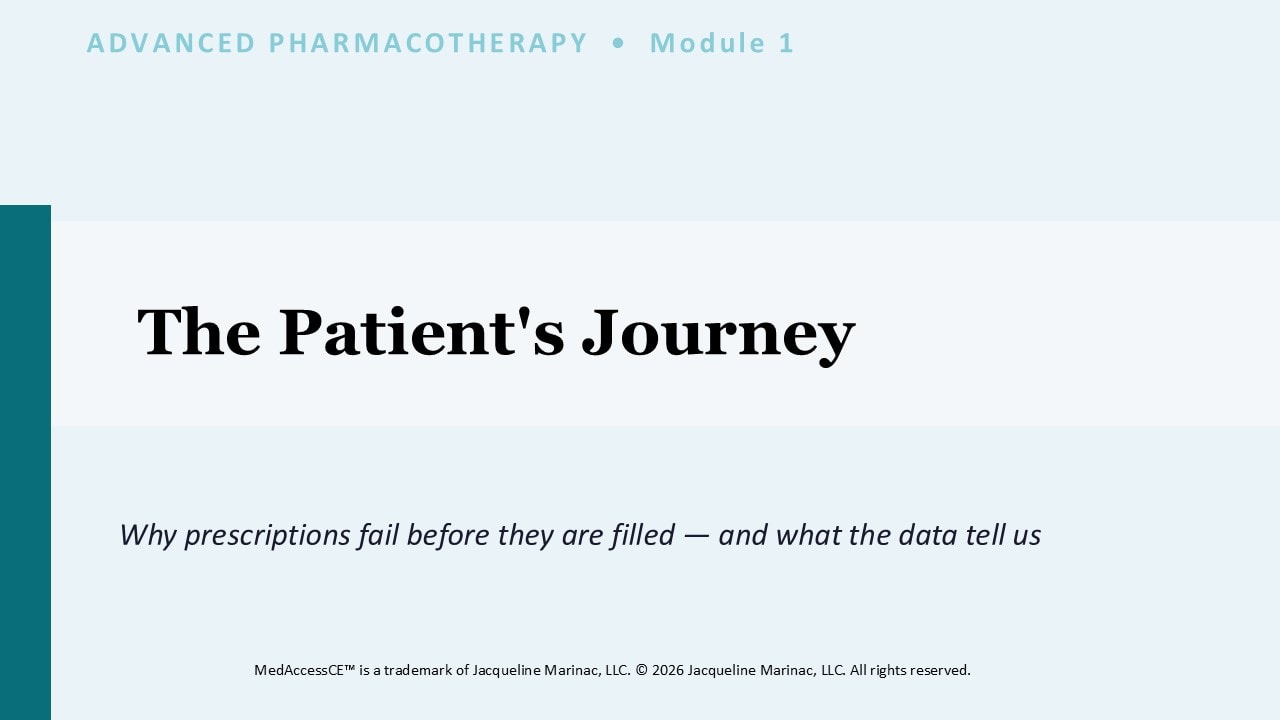
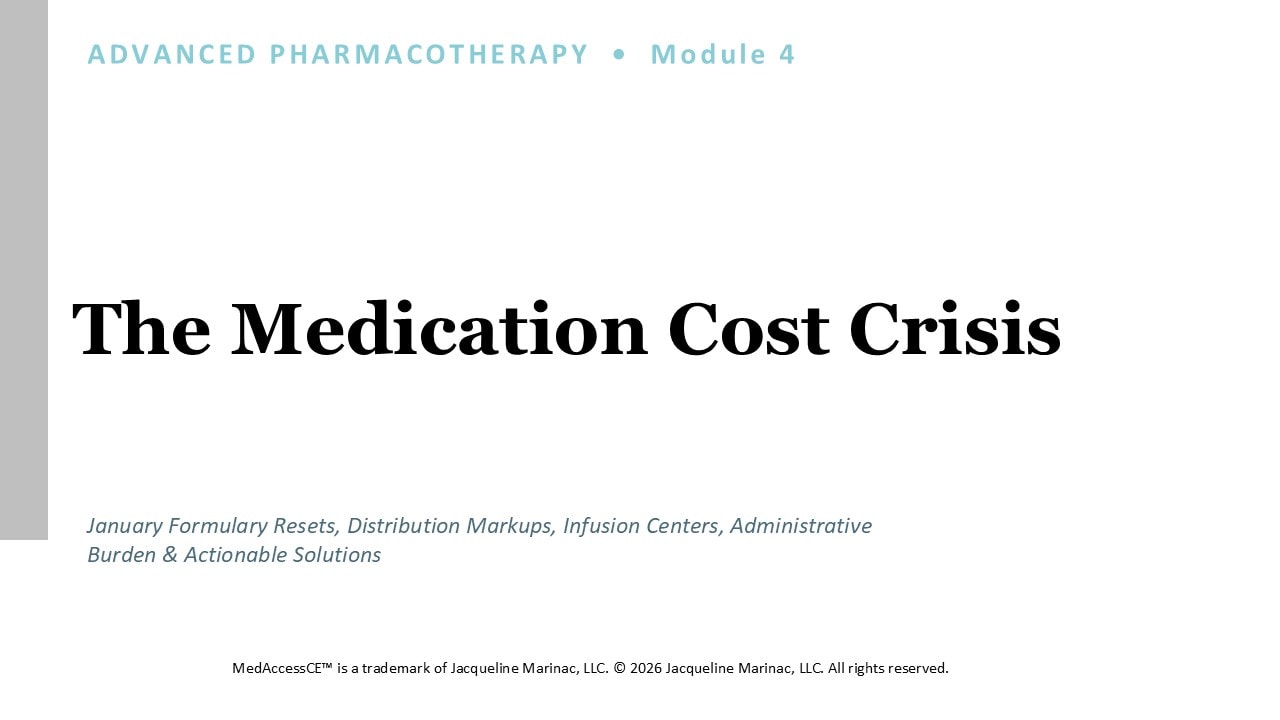
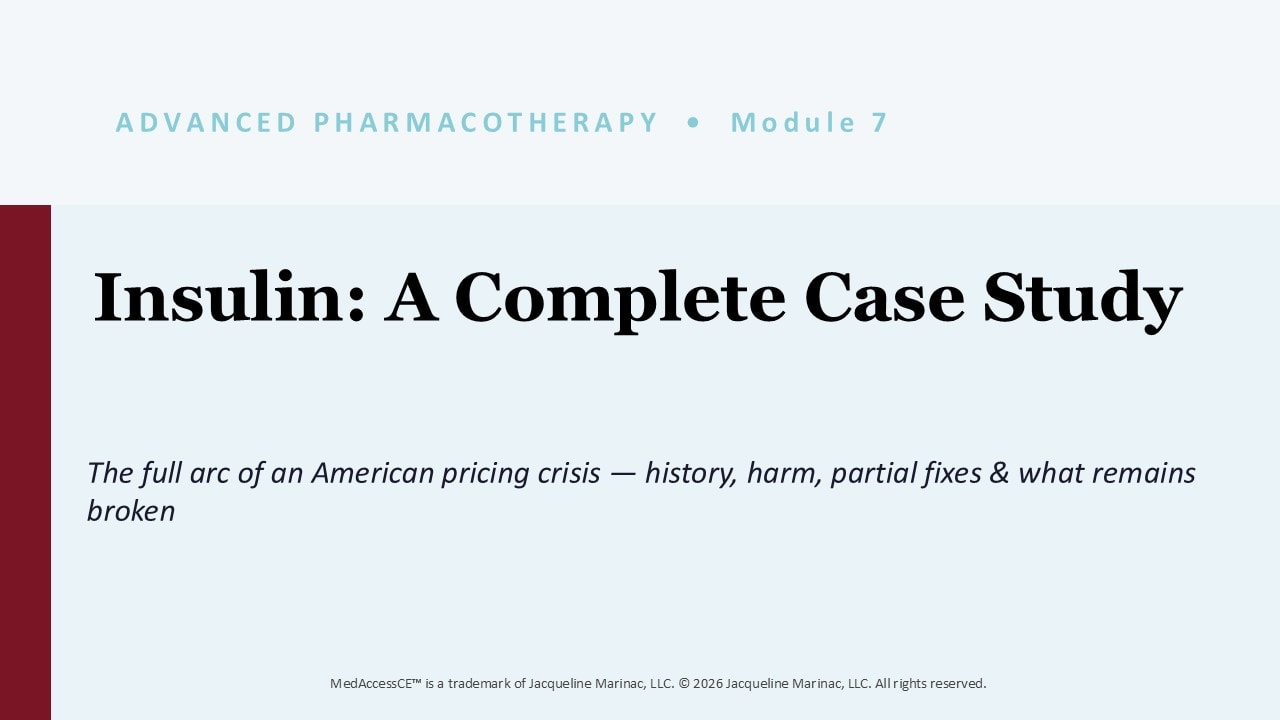
Each module opens with a title slide like these — clear topic framing, a subtitle that tells you exactly what you'll be able to do, and a workbook prompt to apply it immediately.

Free Preview — Medication Access in America: Navigating the System. Modules 0 and 4.
Free Preview
Module 1 — The Patient's Journey: Why prescriptions fail before they are filled.
Module 1
Module 4 — The Medication Cost Crisis: January Formulary Resets, Distribution Markups, Infusion Centers, Administrative Burden and Actionable Solutions.
Module 4
Module 7 — Insulin: A Complete Case Study. The full arc of an American pricing crisis.
Module 7
Common questions

Course & resource FAQ

The evidence

Why clinicians need this course

In 2026, we surveyed 17 clinicians — RNs, APRNs, and PAs — about their experience with medication access barriers. The findings are stark.

Medication Access Needs Analysis — 17 respondents (88% RN, 6% APRN/NP, 6% PA). Kansas and Missouri. Conducted 2026.

The confidence gap47%of clinicians

Nearly half of clinicians are uncomfortable with medication access tools

When asked to rate their overall comfort level with medication access tools on a 1–5 scale, 47% of respondents rated themselves a 1 or 2 — not comfortable or somewhat uncomfortable. Not a single respondent rated themselves fully comfortable (5). The mean rating was 2.35 out of 5.

The training gap76%of clinicians

76% have never received training on medication access tools

Three out of four clinicians surveyed had never received continuing education on medication access tools. Only 17.6% had. This is not a knowledge gap that resolves on its own — it requires structured, role-specific education.

The patient impact41%of clinicians

41% don't know how many patients struggle with medication access

When asked how many patients per month have difficulty affording or accessing medications, 41% said they don't know or don't routinely assess for it. This isn't indifference — it's a system that hasn't equipped clinicians to screen, identify, or act.

2.35Mean comfort rating out of 5 — medication access tools
76%Have never received training on medication access tools
47%Rate themselves uncomfortable with medication access tools
0%Rated themselves fully comfortable (5 out of 5)
Sample pages — preview before you buy

Judge the quality before you commit.

Real excerpts from the certificate course and Clinical Operations Package — included so you can evaluate depth, format, and clinical fit before purchasing or licensing.

Every excerpt below is pulled directly from the course materials. What you see here is representative of the level of specificity, clinical grounding, and ready-to-use format throughout the full course.

From the Playbook

The CLEAR Framework

Fill in before every prior authorization submission.

Element
Fill In
C
Clinical Indication
Diagnosis + ICD-10 + severity + objective findings
L
Line of Therapy
Every prior drug: name, dose, dates, outcome, why stopped
E
Evidence Base
Guideline name + year + specific recommendation
A
Alternative Exclusion
Why formulary alternatives won't work for THIS patient
R
Risk of Delay
Clinical consequences of denial: progression, hospitalization
From the Playbook

Universal Phone Opening

Use for every call — payer, pharmacy, or specialty pharmacy.

Copy-paste ready script
"This is [Name, Credential], calling to [purpose]. Before we begin, may I have your name, reference number, and the best fax for any written submissions?"

Write down: name · reference number · fax · time — every call, every time.

From the Toolkit

Prescriber Workstation Card

Printable, postable reference card — self-contained, no need to reference the rest of the toolkit day to day.

POST AT THIS WORKSTATION — Prescriber Workstation

Before you finish the prescription:

  • Check the real-time benefit tool — is this on formulary at the patient's tier?
  • If PA-required: complete the matching documentation template now, while history is fresh
  • Document prior failed therapies with specific dates, doses, and reasons — vague history is the #1 reason appeals fail
  • Check whether this payer/drug combo has denied before — if so, attach extra guideline support
  • Tell the patient a PA may be required and roughly how long it can take

If it's denied:

  • Confirm the denial states a specific reason — if not, that's grounds to escalate immediately
  • Request peer-to-peer with a same-specialty reviewer within days, not weeks
  • Appeal. 82% of filed appeals succeed — don't skip this step for lack of time

The full Toolkit includes print-ready versions of all workstation cards, templates, and smart phrases.

Organizational licensing

Deploy across your health system

The Clinical Operations Package is available for licensing to health systems, departments, and networks. Contact us to discuss pricing and deployment.

Explore licensing options